
Very Small Feelings

“Maybe I lost my mind. No one noticed. No one noticed”
from “No One Noticed” by Marias ( Album: Submarine)
“How does it feel to be so passing, Tara?” a stranger acquaintance asked me yesterday at Prospect Park while we were watching an impromptu sunset, the peachy pink sky against the backdrop of nude tree silhouettes. “When I first met you, I didn’t realize you were trans,” she continued. I shrugged and perhaps said, “You didn’t?” with my sunset-soaked, glittery eyes, quietly waiting for the familiar flow of validation that often follows such remarks. And it appeared just as expected. “I thought you were a woman, a cis woman.”
I couldn’t help but shake my shoulders slightly, swallow it as a compliment, and smile in thanks for the affirmation. So passing! It felt strange to hear. A rush of emotions tried to grab hold of me all at once, while I pretended to divert the conversation toward Priyanka Chopra and her film The Sky Is Pink. Films, pop culture, and celebrities are usually my strategy in conversations like this - a small way to redirect the moment before the feelings consume me and I forget the ever-contradicting ordinariness of feelings, the small feelings, the very small feelings.
As I walked back home from the park, after the night quietly settled over Brooklyn, I picked up the phone to call a friend so I wouldn’t have to sit with my small feelings - at least not until I reached the refuge of my bedroom, where I could spiral again into the guilt of welcoming my November 2025 back on an unplanned Wednesday evening in March 2026. After all, feelings are the monsters that corrupt our state of mind, as my November from Long Island said in December: “You have feelings for me, Tara, but I don’t have time for emotions.”
In March, he asked me, “Are you still angry with me?” His face was so close to mine. I felt all my feelings trying to escape as I placed my face near his warmth and responded, “I wasn’t angry. I felt rejected. Are you angry with me?”
“I was never angry with you,” he replied.
I wanted to hear more, but he paused. The silence continued, and I found myself becoming even more consumed by feelings for someone who had already said he didn’t have time for them.
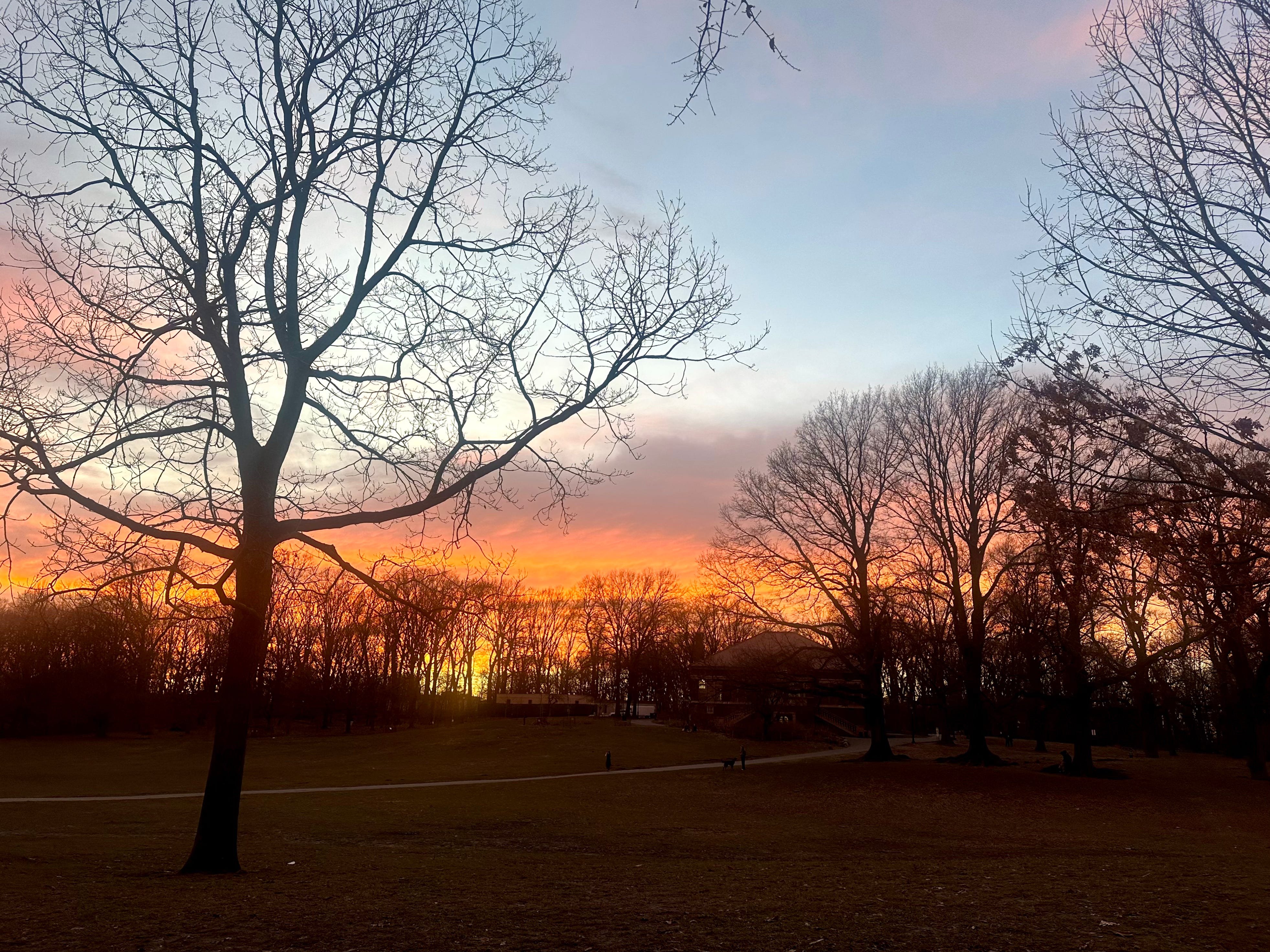
Sunset at Prospect Park: First warm spring evening of 2026
My November wanted me to settle into simply liking each other and fulfilling the desire he hoped to get from me. But instead, I started accumulating many small feelings for him. He suggested that I watch the film In the Mood for Love, and I told him he would enjoy Wong Kar-Wai’s Happy Together. I don’t know if he felt any urgency to watch Happy Together the next day but with all my obedience, I watched In the Mood for Love the next night. The longing and yearning in Wong Kar-Wai’s film chased my mind for days and triggered the quiet paranoia of the impossibility of what I was beginning to desire.
Desiring shouldn’t be so hard. Neither should small feelings. But it seems that, at times, they are the most impossible things one can look for. Wanting someone. Desiring someone. And then slowly becoming too much for that one person you want.
As I continued to accumulate the impossibility of these small feelings for my November, I also found myself thinking again about passing. If passing could offer legitimacy, if it could guarantee the possibility of being chosen, then why am I still not chosen yet?
What I feel is a constant chase.
I am chasing my desires, and my desires are chasing me. A contradictory, never-ending game we seem to be playing with each other. Me and my Desires.
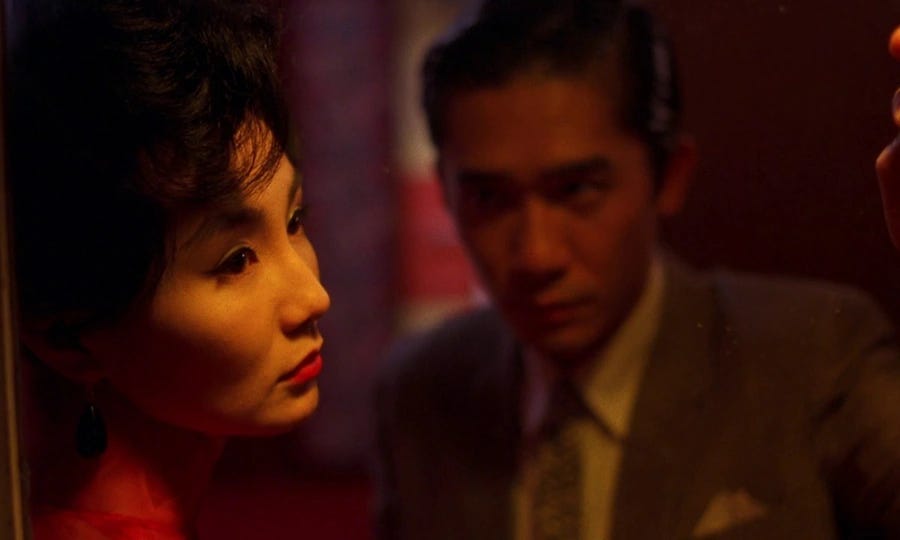
In the Mood for Love, Wong Kar-Wai, 2000
~~~~~~~~~~~~~~~~~~~~~~~~~~
While thinking about my small and inconvenient feelings over the past few months of early 2026, I also found myself returning to conversations I have had over the years with the Bangladeshi artist and friend Farzana Ahmed Urmi. I have known Urmi for more than a decade now, since my early days as a young art student wandering through the studios of Charukala at the University of Dhaka in Bangladesh, moving between studio work, gallery visits, and long afternoons of conversation about art, life, and whatever feelings happened to occupy our minds.
Over the years, our conversations continued, sometimes in person, sometimes across distance. They rarely stayed, only about art. They drifted easily into other territories: desire, friendship, loneliness, the slow disappearance of connections, the strange ways feelings settle into the body, and eventually appear somewhere else.
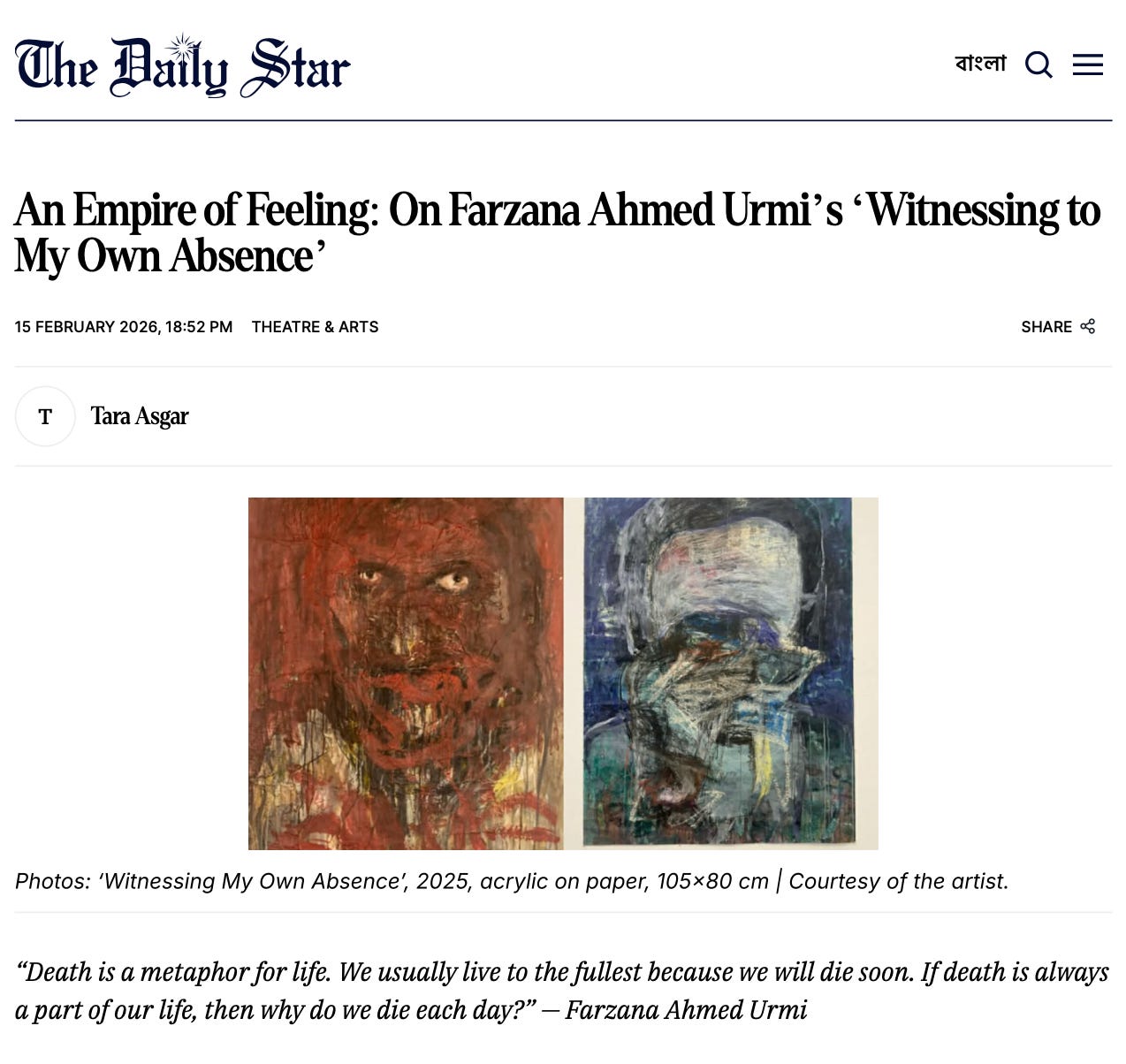
Recently, I wrote a short piece about her paintings, after many long conversations about her recent body of work, part of a solo exhibition she staged at the artist-run space Kalakendra in Dhaka, titled Witnessing to My Own Absence. Urmi’s paintings carry something quieter about the everyday dealing with small feelings. They do not dramatize feeling. They allow it to drip and dissolve into faces that become almost unrecognizable. Almost the way certain memories remain in the body without demanding explanation.
An Empire of Feelings, as I described Urmi’s paintings in the piece published in The Daily Star this February. You can read the article on this link: An Empire of Feeling: On Farzana Ahmed Urmi’s ‘Witnessing to My Own Absence.’
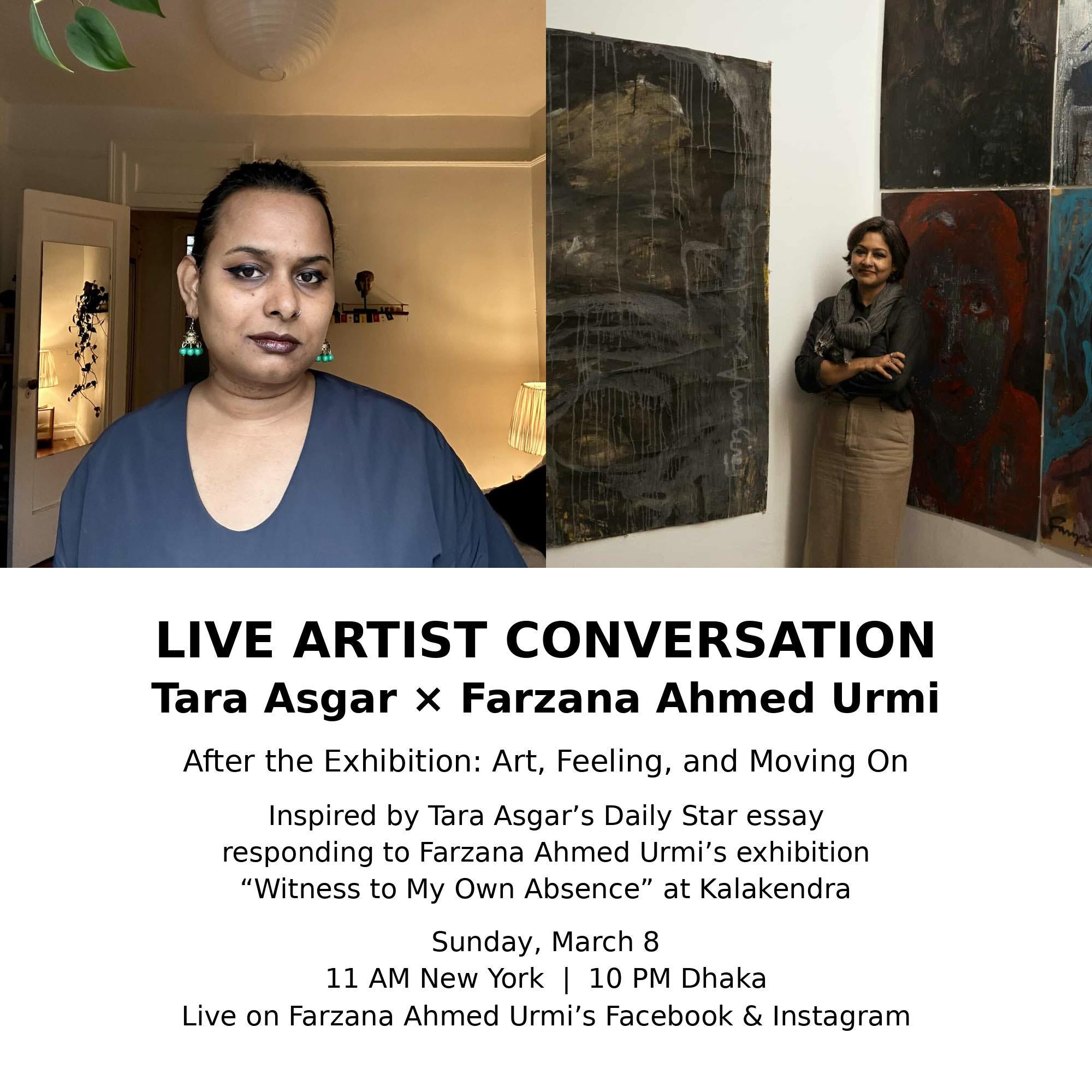
Past weekend, I was also lucky to catch up with Urmi over an online art chat to talk more about very small feelings, her practice, and the untranslatable emotional labor of artistic practice.
~~~~~~~~~~~~~~~~~~~~~~~~~~
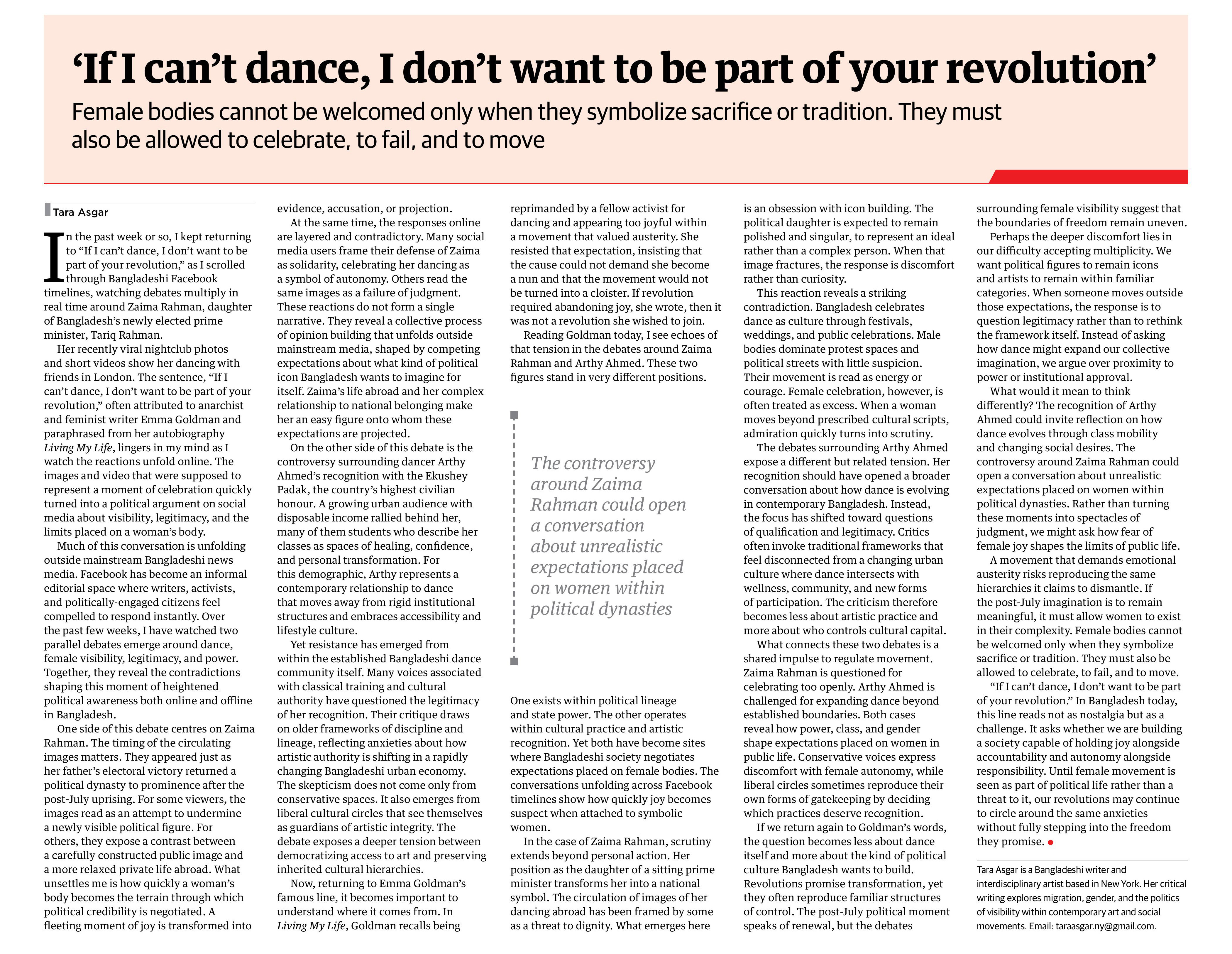
As I look into my past few months, I can see how the idea of feelings has been quietly following me in other spaces. Earlier this month, I wrote an op-ed for Dhaka Tribune titled “If I Can’t Dance, I Don’t Want to Be Part of Your Revolution.” The piece reflects on a moment I kept watching unfold on Bangladeshi social media, a young woman dancing freely with friends, and the strange discomfort that image seemed to provoke. I have borrowed the title from Emma Goldman’s writing as a lens to think through questions of female visibility, cultural legitimacy, and the politics of joy in the post-July moment in Bangladesh.
While writing it, I realized I was still circling the same question that had been retoating in my conversations with Urmi and in my own small encounters with strangers over the past few months: the uneasy relationship between feelings, acceptance of others, and the worlds we inhabit around. In the article I wrote,
“Perhaps the deeper discomfort lies in our difficulty accepting multiplicity. We want political figures to remain icons and artists to remain within familiar categories. When someone moves outside those expectations, the response is to question legitimacy rather than to rethink the framework itself.”
The tension between what we feel and what we are allowed to feel. Between the seriousness that politics demands from us and the fragile emotional worlds we continue to carry privately.
You can read the full op-ed article here: ‘If I can’t dance, I don’t want to be part of your revolution.’
~~~~~~~~~~~~~~~~~~~~~~~~~~
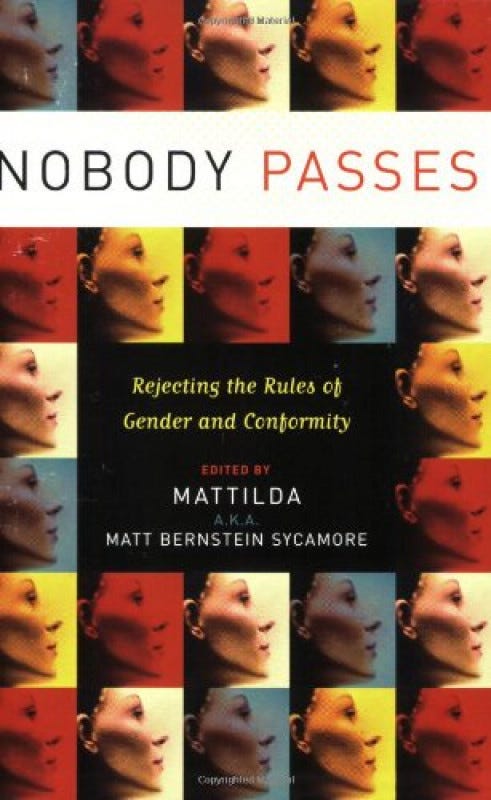
And to circle back to passing, I have returned to Matilda Bernstein Sycamore’s Nobody Passes after many years, a book I first encountered during my MFA and have carried with me across different places since then. In her introduction, Matilda proposes questions and tells the reader that this collection of edited essays “tears binary gender norms to shreds, and proceeds to embrace, challenge, and transform not only the categories of ‘man’ and ‘woman,’ but the categories of femme, transgender, butch, genderqueer, and ‘none of the above, thank you.’”
Nobody fully arrives at the version of themselves that the world asks them to perform or pass. Perhaps we are all moving through small negotiations with ourselves, carrying feelings we do not always know how to place.
And it is difficult not to feel many things right now. The world seems to be shifting constantly, often in frightening and unpredictable ways. Wars and political anxieties are unfolding across continents, but there are also the smaller landscapes of our everyday lives. Lovers who appear and disappear. Friendships that slowly lose their shape. Rejections that stay longer than we expected. Conversations at sunset that trigger emotions we were not prepared to feel.
Sometimes there is no obvious place to deposit these feelings. Our very small feelings.
Love that you name them by the months and time passing - so many strangers we've loved and let go of